On 30 October 2026, APR reported that Medicube had passed KRW 2 trillion in sales during the first nine months of the year. The group's third-quarter revenue reached KRW 773.1 billion, roughly double the previous year's quarter. Beauty-device sales, however, fell 17.9%. The business that helped Kim Byung-hoon persuade investors to see his company as a technology enterprise was moving in a different direction from the skincare business carrying its latest growth.
That contrast matters because APR's history is often told backwards, starting with the device and explaining everything else through it. Kim established the company in 2014. Medicube skincare followed in 2016; AGE-R devices arrived in March 2021. By then the business had already raised outside capital and established several brands. The latest sales mix brings the earlier skincare operation back to the centre of the story.
The expansion also changes what it means to own a Korean beauty company. APR says overseas customers supplied 94% of third-quarter revenue, with North America and Europe together accounting for 69%. Korean product development now supports a business whose largest customer groups are abroad. North America supplied 46% of quarterly revenue and Europe 23%, up from a combined 47% a year earlier. The expansion is changing Medicube from a Korean online seller into a brand that consumers can encounter in large local retail chains.
Kim Had a Skincare Business Before He Had a Machine
APR's early attraction was its ability to sell through its own websites and social media. DealSite's January 2024 account traces a KRW 5 billion Series A in 2017, followed by approximately KRW 27.7 billion in 2018. Investors backed an expanding consumer company years before AGE-R's launch. Their money helped support overseas subsidiaries and a wider collection of brands. This was a period of spending and experimentation: the report describes a loss in 2018 followed by a return to profit in 2019.
The move into devices added a different kind of commitment. APR established a device research centre in September 2022 and opened its first device factory in July 2023. A second production campus followed in May 2024. These decisions put development and manufacturing inside a company that had become known for reaching consumers online. A successful demonstration could now sell something more expensive than a cream, while a faulty product would create manufacturing and after-sales responsibilities.
Kim later recalled investor scepticism about the high-priced category when AGE-R began in 2021, according to an August 2026 account of his Forbes interview in the Korea Economic Daily. His decision makes more sense in that sequence. He was asking an established skincare audience to try a new way of using beauty technology, with a sales organisation already behind him. The outcome depended on more than an attractive gadget appearing in a video.
CJ Brought an Audience as Well as Capital
Access to the stock market took longer than a neat founder-success story suggests. DealSite reported that an earlier listing attempt had encountered questions about the ownership structure after a co-founder's departure. Institutional purchases of existing shares in 2021 and 2022 helped reorganise that ownership. The ownership reorganisation preceded a more practical alliance with a company that could put the products in front of shoppers.
By June 2023, CJ Onstyle had become a strategic investor. In its own February 2024 account, CJ described promoting Medicube across television and mobile live commerce and taking KRW 4.2 billion of orders over five Booster Pro broadcasts. The partner gave APR a way to explain the new device across television and mobile shopping, alongside its own direct selling. APR filed for listing review in September 2023 and joined the KOSPI in February 2024, after this commercial relationship was already under way.
The British Shopping Screen Came Before the European Shelf
Medicube entered TikTok Shop in Britain in October 2024. APR's subsequent Sephora announcement says the brand reached first place in the platform's beauty category in the first week of February 2025. That is a company-reported platform ranking, but the chronology is useful. The European opportunity did not begin when a prestigious retailer agreed to stock the products. Digital selling had already given Medicube a route to buyers.
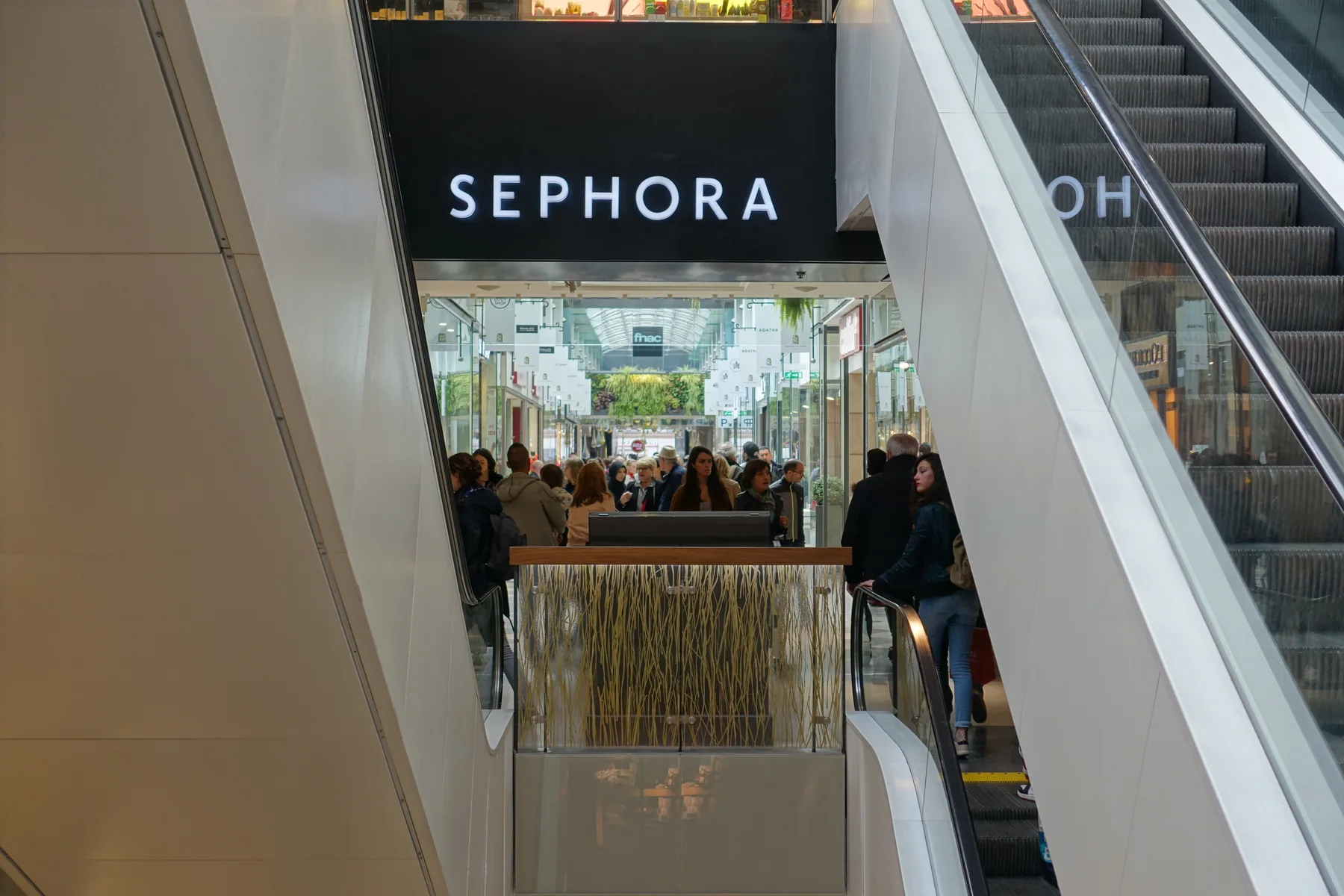
In March 2026, APR announced a phased Sephora programme intended to reach about 450 stores in 17 countries. Zero Pore Pad 2.0, PDRN Pink Peptide Serum and Collagen Night Wrapping Mask led the selection. France, Germany, Italy and Spain were among the named markets. These were recognisable skincare products with existing digital audiences: the retailer was giving those shoppers a local place to examine and find them again.
The September announcement of demonstrations in New York, Los Angeles, London and Paris belongs to the next stage of that effort. The proposed trade-ins and consultations centred on Booster Pro X2. They gave APR a format for explaining an upgrade while also displaying skincare. APR scheduled New York for 10-12 September, Los Angeles for 25-27 September, London for 9-11 October and Paris for 23-25 October. Skin consultations and recommended device settings made explanation part of the format, alongside the ability to buy products on site.
Joe Cho Takes Medicube Beyond the Beauty Counter
Medicube's April 2026 Coachella plan brought the same ambition to a different audience. In a first-hand Forbes interview, media-relations team lead Joe Cho said he wanted Medicube to become a mainstream brand, beyond its K-beauty identity. As the festival's official skincare partner, it planned karaoke booths, a small performance stage and places where festivalgoers could prepare their makeup. Cho described an effort to make the products useful within the event, with vanities for people staying in cars as well as gifts for glamping guests.
The product choices fitted that setting: a smaller Mini Booster Pro and attachments, mists and eye patches, alongside the US-first introduction of a rosemary PDRN haircare line. These were plans described before the festival. They show the range of work behind Medicube's expansion: a Korean device-and-skincare company was finding occasions to introduce new categories far from a conventional beauty demonstration. The karaoke idea also gave the campaign a social activity of its own, beyond asking visitors to watch another product video.
Skincare Pulls Ahead as Device Sales Fall
By its third-quarter presentation, APR reported more than eight million cumulative device sales. Yet quarterly device revenue was only KRW 84.7 billion, down from KRW 103.1 billion a year earlier. Cosmetics and beauty products accounted for 88.3% of group sales. The device business remained substantial; the latest increase in company revenue came from elsewhere.
The change followed a stronger device quarter. In April-June, device revenue had grown 24.3% to KRW 111.9 billion; APR also introduced Booster Glow. Its October presentation attributed the subsequent fall to a quarter without major global sales events. Cosmetics kept growing through established bestsellers and newer products. The two businesses were no longer moving together: skincare was bringing in enough demand to lift group sales even as device revenue retreated.
Preliminary Q3 2026 consolidated revenue, rounded from KRW 773,115 million.
Source 6Cosmetics / Beauty category's share of APR's preliminary Q3 2026 consolidated revenue.
Source 6Preliminary Q3 2026 consolidated operating margin under K-IFRS 1118.
Source 6A Stronger Won Interrupts the Profit Climb
Third-quarter operating profit reached KRW 160.6 billion, below the second quarter's KRW 190.6 billion despite a small increase in revenue. APR estimated KRW 27.8 billion of currency pressure. A stronger won reduced the translated value of foreign sales and produced losses on foreign-currency receivables. The reported margin fell from 24.8% to 20.8% on the same accounting basis. This was a tangible setback within the expansion: the company sold more, yet kept less operating profit than in the previous quarter. Its growing North American and European business had also made currency movements more consequential.
KRW 160,640M / KRW 773,115M = 20.8%Q3's reported margin compares with 24.8% in Q2 on the same K-IFRS 1118 basis. APR estimates that currency effects reduced the Q3 margin by 3.6 percentage points.
Medicube Prepares for the Year-End Shopping Season
APR's October release names Target, Walmart and Costco among its expanding US channels and describes a planned entry into roughly 3,000 CVS stores during the year. The CVS programme would put the brand into a pharmacy network as well as mass-market and warehouse retailers. APR's announced fourth-quarter plan paired those wider shopping routes with products and promotions adapted to local demand around Black Friday and Christmas.
The American expansion brings routine responsibilities alongside the marketing. MoCRA requires relevant cosmetic facilities and products to be registered or listed, safety records to be maintained and serious adverse events to be reported, subject to the law's exemptions. Product and customer-service organisation must grow with the retail presence. Medicube's immediate commercial position is nevertheless stronger than a device-only account would suggest. Its skincare sales have become large enough to carry the group through a weak device quarter, and established retailers are opening more ways to buy them. Kim's company is now being reshaped by the earlier business he built, not solely by the technology that made its later reputation.
DSML research · 15 October 2026 · Revised 31 October 2026