Reported evidence.
PlayStation records 27 March 2025 as the release date for Nexon-published The First Berserker: Khazan. The Korean Neople game extends the Dungeon & Fighter setting into a single-player action role-playing product. Nexon’s May results describe the global debut as 28 March and state that first-quarter title revenue was below its outlook, while characterizing the launch as a strategic step in introducing the franchise globally. The same release identifies Tencent pre-registration for a Chinese adaptation, not a completed mainland launch.
1. PlayStation / Khazan release, publisher and language specifications2. Nexon / first-quarter 2025 results and title performance3. Nexon / first-quarter investor presentation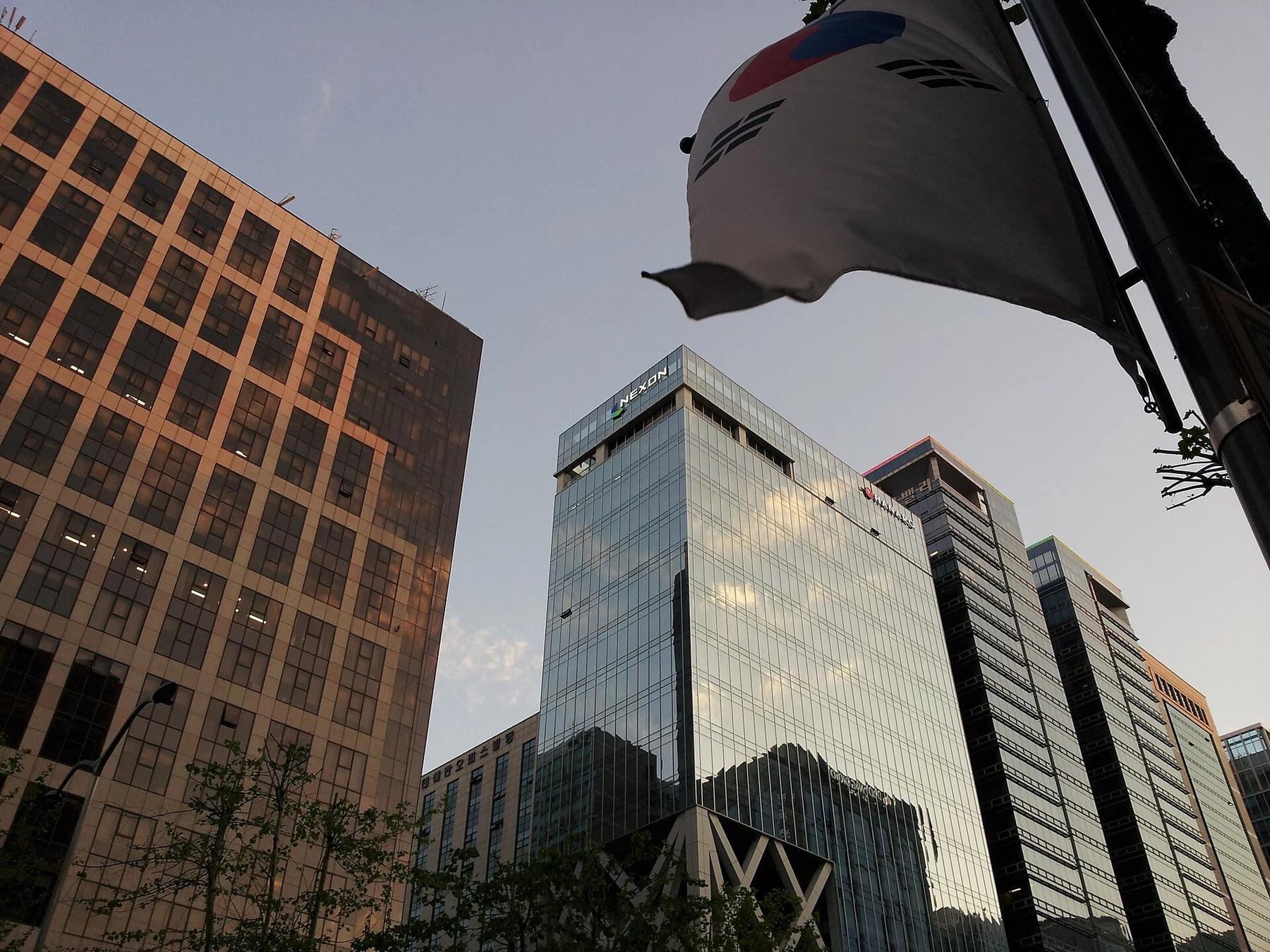
Photograph source · CC BY-SA 3.0 for the photograph; attribution, change notice and share-alike for image derivatives. Separate architectural/trademark rights and endorsement are not granted.
Investment interpretation.
A premium game can introduce an established Korean franchise to players who prefer a self-contained purchase over a persistent online service. The strategic opportunity is real, but the economic model changes. Development and launch spending are recovered from paid copies and later windows rather than from the same recurring relationship as the legacy game. Familiar intellectual property reduces some discovery work without guaranteeing that its existing audience purchases the new format.
Economic assessment.
Separate the title’s net sales and continuing support cost from the larger franchise’s performance. Nexon reports franchise growth alongside a title that missed its own revenue outlook; the aggregate movement cannot establish Khazan’s return. The public evidence does not disclose development cost, net receipts per copy or title profit. Strategic audience expansion should be measured as an additional benefit, not used to replace the requirement to understand the cash invested.
Recognition Without Automatic Conversion
Dungeon & Fighter recognition can make the setting and characters easier to communicate. A single-player action buyer nevertheless evaluates combat, presentation, difficulty and the experience available for one purchase. An existing franchise player may enjoy a different style of interaction and have no interest in that proposition. The conversion between audiences must therefore be demonstrated, not assumed from the legacy brand’s scale.
The title also competes with established premium action games whose appeal does not depend on an online franchise. To win that comparison, the Korean studio must deliver a product that stands on its own. Creative identity can support differentiation, while production quality and usability determine whether the distinction is valued. Marketing should be judged by the buyers it creates at an acceptable acquisition cost, not by awareness among people who recognize the underlying franchise but do not intend to purchase.
Localization Before Territory Earnings
The platform’s language list establishes that the product was prepared for multiple audiences. Voice and text work create up-front costs and quality-control obligations, with different amounts of reuse across territories. A Chinese-language option does not establish a mainland commercial release, just as Japanese voice does not prove the size of Japanese receipts. Distribution access and localization are related but distinct inputs to monetization.
The capital allocator should prioritize language and platform work according to expected contribution and the quality required to compete. A localized premium title can be offered internationally without building the same operating footprint as a persistent local online service. It still requires customer support, platform compliance and appropriate promotional material. The return on that preparation should be measured with actual purchase cohorts rather than by counting the number of language options as equivalent markets.
Strategic Reach Needs a Baseline
Nexon explicitly describes the title as an early step in a broader franchise expansion. That explains why management might accept a financial result below the original outlook, but it does not make the spending unaccountable. The strategic review should identify what the launch taught about new audiences, what reusable production capabilities were created and how subsequent projects benefit. Those benefits require a baseline against which additional investment can be judged.
A franchise extension can generate options for later products, but options become valuable through informed choices rather than automatic continuation. If a new audience values the setting but resists the format, the next project may need a different product or distribution approach. If the product is strong but acquisition is expensive, better discovery or a longer sales window may be preferable to another large development commitment. The initial title’s result should sharpen allocation decisions, not simply be absorbed into a broad global ambition.
Korean Production and Group Reporting
The Korean studio’s production role should remain visible even though the listed Nexon reporting entity is in Japan and platforms operate internationally. Legal entity, creative origin and customer location are different classifications. A group earnings release supplies useful evidence about title performance, but it does not show the exact cash balance or contractual allocation at Neople. Any financing analysis must identify the entity that owns the relevant rights and receives settlement.
For realization, a purchaser would examine the franchise rights, source assets, platform arrangements and continuing support obligations. The ability to reuse a world across titles can increase strategic value, yet rights and production capability must survive the transaction. Khazan is a useful case because it presents a completed commercial release and an explicit expectation shortfall. It permits an economic discussion that values creative reach while retaining a concrete test of what the new purchasing model earns.
Geographic analysis.
China
Reported connectionNexon identifies Tencent pre-registration for a Chinese adaptation. That is a distribution preparation milestone, not proof of completed mainland sales or collection.
Japan
Reported connectionThe listed reporting entity is in Japan and Japanese voice is available. Neither fact defines title-level Japanese profit or the Korean studio’s cash allocation.
Other Asia
Reported connectionKorean Neople production extends an established Korean-origin franchise into a premium product. Regional purchases must be measured separately from legacy online demand.
United States
Reported connectionThe US PlayStation record gives a local 27 March release date and language specifications. The platform listing does not disclose net developer receipts.
Europe
DSML comparisonEuropean text preparation supports accessibility, while price, refunds and discovery determine contribution. No European title revenue is disclosed in this evidence.
Counterpoint.
A strong standalone game may create valuable new franchise recognition even when initial receipts miss expectations. That strategic effect deserves analysis, but it should not erase the production cost or substitute franchise growth for title recovery. The strongest follow-on decision uses observed audience and pricing evidence to determine whether to extend, modify or limit the next commitment.
Underwriting questions.
- What cumulative title receipts remain after platform settlement, refunds and ongoing support?
- Which audience gains are incremental to existing Dungeon & Fighter customers?
- What reusable rights and production capabilities justify the next franchise investment?
Primary sources.
- PlayStation / Khazan release, publisher and language specificationsRelease record 2025-03-27; checked 2026-10-08
- Nexon / first-quarter 2025 results and title performance2025-05-13
- Nexon / first-quarter investor presentation2025-05-13
DSML research · 8 October 2026