Reported evidence.
Olive Young announced its Pasadena store on 22 May 2026 and subsequently confirmed the May 29 opening. The announced format covered 8,647 square feet, about 400 brands and approximately 5,000 products, together with a dedicated US online offer. Company materials described skin-analysis and consultation services. The disclosed size and assortment do not establish sales density, repeat purchase, store-level profitability or the commercial outcomes of planned later stores.
1. CJ: Pasadena opening announcement2. CJ: opening confirmation and operating model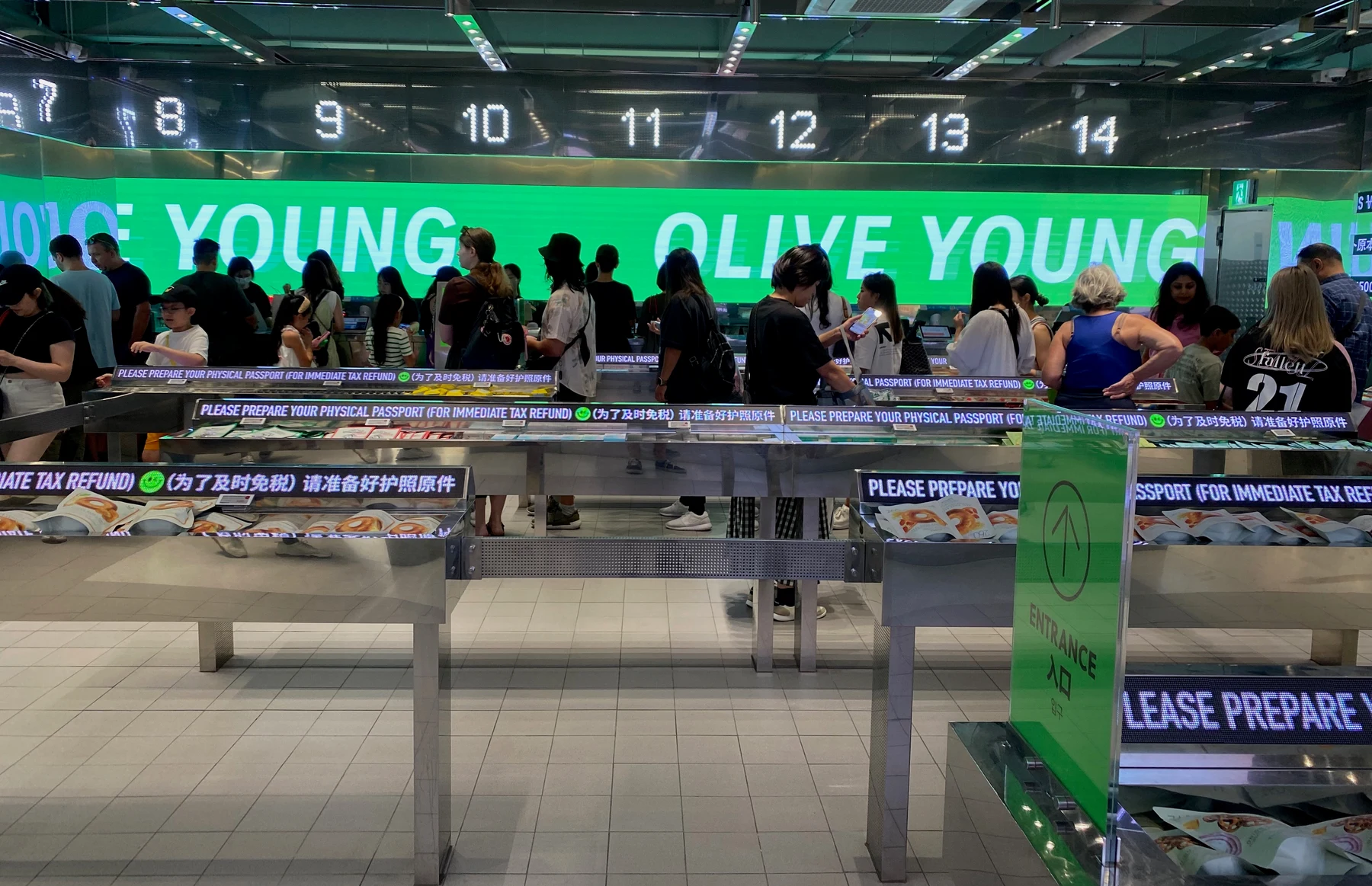
Investment interpretation.
Owned retail changes the internationalization problem from supplying a foreign buyer to operating a foreign customer relationship. Olive Young can decide assortment, service and presentation, and can connect a first visit to online replenishment. Those capabilities may reveal demand that a wholesale arrangement would conceal. They come with a larger operating perimeter: staff, occupancy, stock, returns and domestic service. Pasadena is therefore a test of a Korean retail model's transferability, not simply another distribution door for participating brands.
Economic assessment.
A flagship can earn a retail spread while consuming more capital than a wholesale route. The appropriate comparison deducts local staffing, rent, fulfillment, shrink, samples and marketing before assigning strategic value. The announced free-shipping threshold can support basket building but may also subsidize small or heavy orders. In-store discovery and later online purchases should be assessed as one customer journey without double-counting acquisition value. No public source supplies the needed unit economics, so the case identifies operating mechanisms rather than imputing margins.
Translating Service, Not a Floor Plan
A Korean store's service process is not automatically understood abroad. Product names, ingredient familiarity and expectations about consultation can differ. The retailer needs recommendations that help customers make a decision without requiring them to learn an entire beauty taxonomy. Skin analysis and routine guidance can reduce uncertainty, but their commercial value depends on whether customers trust and use the recommendations.
Staff training is therefore an operating investment, not merely an opening ceremony. Knowledge must be retained when teams change, and recommendations must remain consistent as the assortment evolves. A usable process converts expertise into concise product choices and repeatable service. Copying fixtures without reproducing that process would preserve the visible format while losing the reason the format might earn a premium over ordinary product availability.
Breadth Versus Stock Complexity
A broad range creates discovery value because consumers can compare multiple Korean labels in one visit. It also divides demand across many stockkeeping units. An opening assortment can be impressive while holding insufficient depth in the few products customers repeatedly want. Conversely, carrying deep stock in every item can lock cash into slow-moving lines. The assortment's economic task is to balance variety with dependable availability.
The retailer should distinguish attraction products, routine replenishment items and experimental products. They have different roles and reorder standards. A product that helps customers enter the store can be useful despite modest direct sales, but that role needs evidence rather than indefinite protection. The large opening catalogue makes disciplined pruning important. More brands are not inherently a stronger business if complexity raises service cost and weakens purchasing focus.
The Second Purchase
The online channel can preserve the relationship after a shopper leaves the neighborhood. For consumable skincare, the repeat purchase may occur weeks later when the product runs out. A convenient domestic route can capture that demand more effectively than a store-only model. The important measure is contribution from repeat cohorts after delivery and support costs, not merely the number of accounts created during the opening period.
Online availability also exposes the store to price comparisons. Customers can inspect products in person and buy elsewhere if competitors offer materially better value. The retailer's defense can include reliable availability, a coherent routine and useful services, rather than permanent discounts. A combined store-and-online model succeeds when each channel improves the other's economics. It fails when the store subsidizes free advice while the online business subsidizes expensive delivery.
A Shared Foreign Shelf
For smaller Korean labels, the store offers a shared route to a customer base that would be expensive to reach individually. The retailer can aggregate explanation and trust. Yet supplier economics remain distinct from retailer economics. A supplier may earn on initial stock while contributing to launch support, or face terms that make a visible listing less profitable than a less prestigious wholesale account.
The retailer's role should therefore be judged by the quality of supplier development as well as its own customer proposition. Timely product feedback, manageable minimums and clear replenishment expectations can help brands sustain the route. Excessive assortment churn can leave small firms with stranded packaging or stock. No terms are public here, so the analysis does not assume either favorable or unfavorable treatment. It explains why platform scale and supplier health need separate monitoring.
A Store as an Operating Prototype
The first location can produce knowledge about US labor scheduling, product questions and basket patterns. That knowledge has value if it changes later store design and online merchandising. An opening queue, by contrast, is concentrated attention around a scarce event. It cannot establish ordinary-week demand or the productivity of stores in less visible locations. The relevant learning begins when the exceptional opening traffic subsides.
Further expansion should follow a repeatable contribution model rather than a store-count ambition alone. Different neighborhoods may require different ranges and service intensity. A smaller location could capture routine purchases while a flagship supplies discovery. The company describes additional plans, but this case counts only the first realized opening. The potential network advantage is a calibrated set of formats sharing inventory and customer insight, not uniform replication of an expensive launch.
Geographic analysis.
China
DSML comparisonOwned mainland retail would face a separate operating environment. No Chinese store expansion is established by Pasadena.
Japan
DSML comparisonJapanese multi-brand retail offers a comparison for service and assortment depth; Pasadena supplies no Japanese revenue disclosure.
Other Asia
DSML comparisonSoutheast Asian formats might favor different routines and price points. A Korean concept's US arrival is not evidence of regional Asian transferability.
United States
Reported connectionThe first US store actually opened in Pasadena. The record distinguishes that completed event from the company's later expansion plans.
Europe
DSML comparisonThe Gabona private-brand route delegates commercialization, whereas Pasadena owns retail. They test different levels of control and fixed cost.
Counterpoint.
The first store may be a rational learning investment even if its early contribution is below a mature target. A company can deliberately pay for operating knowledge. That argument requires a defined learning agenda and later evidence that decisions improved. Otherwise every weak store can be defended as strategic indefinitely, obscuring the cost of international expansion.
Underwriting questions.
- What does an ordinary-week store contribute after fully allocated local costs?
- How many first-store customers reorder through the US online channel?
- Which lessons change the capital and staffing needs of the next location?
Primary sources.
- CJ: Pasadena opening announcement2026-05-22
- CJ: opening confirmation and operating model2026-06-12
DSML research · 8 October 2026