Reported evidence.
CJ Foodville’s 10 June 2025 release identifies a 4 June launch announcement for TOUS les JOURS at Sunway Pyramid under a January master-franchise agreement with Stream Empire Holdings. It describes an approximately 200-square-meter bakery café and plans to use an existing Indonesian production facility for Malaysian logistics and operating support. A second outlet was planned for Sunway Velocity later in June. The mall’s own directory identifies the operating tenant; neither source discloses royalties or franchisee profitability.
1. CJ Foodville / Malaysia launch, master-franchise partner and regional supply strategy2. Sunway Pyramid / operating TOUS les JOURS tenant directory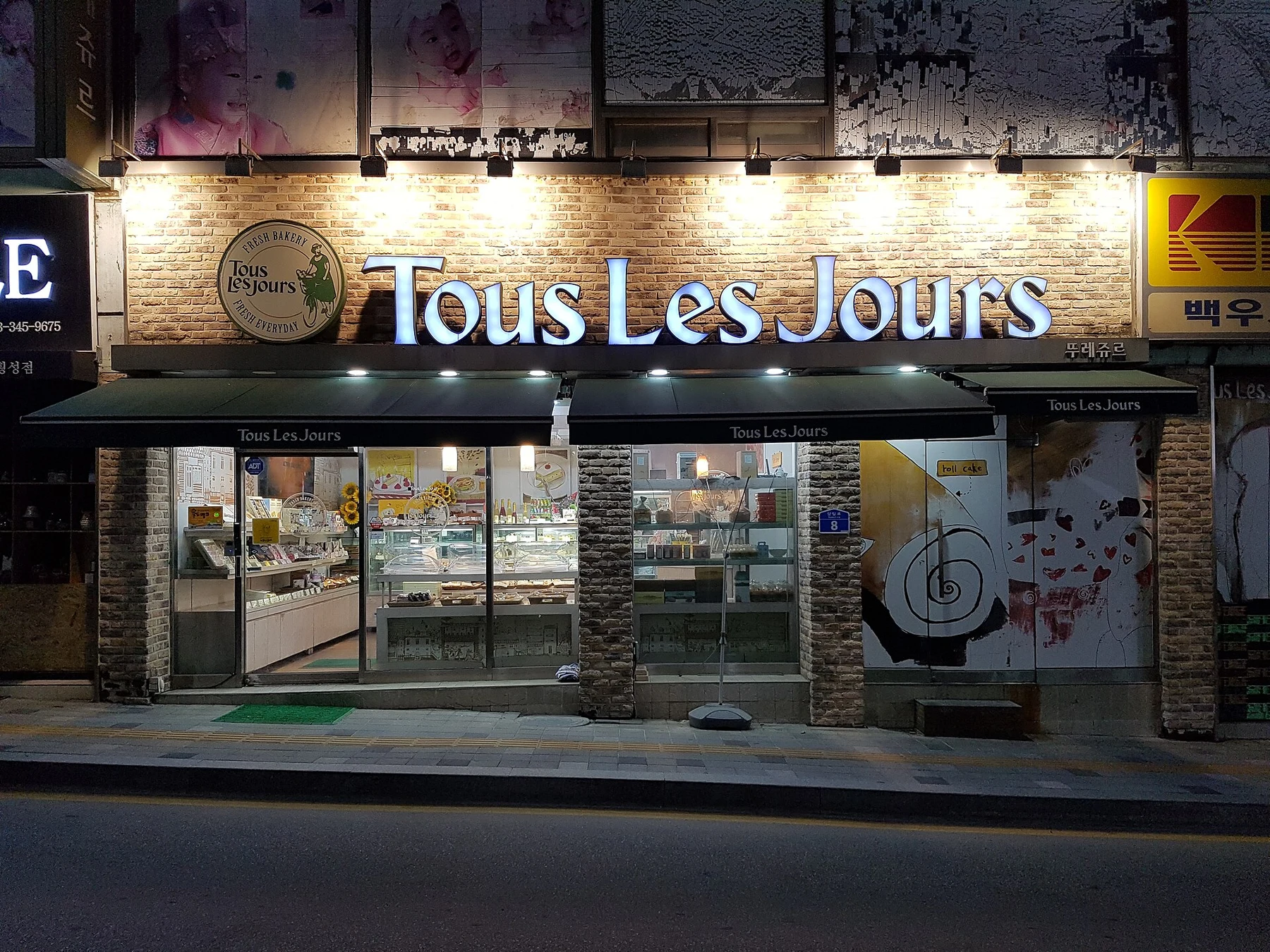
Photograph source · CC0 1.0 dedication for the photograph; separate trademark and other rights are not waived.
Investment interpretation.
The master-franchise structure combines Korean brand and product know-how with a local partner’s storefront execution. The Indonesian production base adds a regional supply option that a standalone new-market entrant might lack. The investment opportunity is therefore in the architecture of the operating system: localized product demand, partner incentives and reusable production support. It is not a simple multiplication of Malaysian store openings by Korean café margins.
Economic assessment.
Separate the Korean brand owner’s contractual income from the Malaysian partner’s retail receipts and any Indonesian supply contribution. These streams can have different costs, currencies and settlement timing. The release states the intended use of regional production but does not establish transfer prices, mandatory purchase volumes or the ownership of every local asset. Store area provides an operating constraint, while the return on the master-franchise agreement depends on the actual commercial obligations.
The Local Partner Decision
A master franchise is a choice about who supplies capital and who executes local growth. The Korean company can extend its brand without directly funding every café, but gives the partner a significant role in site selection, staffing and local customer experience. That can improve market access when the partner understands the retail landscape. It can also concentrate execution risk in one counterparty. The structure’s value depends on capabilities and contractual alignment, not merely on labeling expansion asset-light.
Stream Empire Holdings is the named partner, making the counterparty relationship a specific diligence subject. Examine development commitments, exclusivity, quality standards and the remedies available if rollout or service falls short. These are questions about the agreement rather than terms supplied by the public release. A geographically broad grant can be valuable to the partner while limiting the Korean company’s ability to appoint another operator; that opportunity cost should be considered alongside the expected fee stream.
A Bakery Café, Not Only Bread
CJ describes a product range spanning breads, cakes, sandwiches and beverages. The café therefore competes for several consumption occasions and uses its footprint for both product display and customer dwell time. A premium position can support basket size, but a broader range creates preparation and inventory complexity. The relevant measure is contribution by product and time of day, including spoilage and the opportunity cost of occupied seating, rather than a headline claim that Korean bakery demand is growing.
The mall location gives access to established foot traffic while exposing the store to competing cafés, restaurants and discretionary retail. Mall traffic is not a purchase commitment. The product mix must make the store a destination or capture a sufficient share of passing customers at an economic cost. The directory confirms the tenant’s presence, while the company release supplies the intended concept. Neither establishes conversion rates, customer frequency or the contribution of a particular menu item.
Reuse of Indonesian Capacity
The existing Indonesian production facility is commercially important because it may support a new territory without repeating a full manufacturing investment. That is a regional operating option, not evidence that all Malaysian products are already supplied from Indonesia. Cross-border replenishment can spread fixed production cost, but transport, product handling and local adaptation determine the delivered economics. Local preparation remains necessary where freshness or customer preferences make centralized supply less suitable.
The capital comparison is between using regional capacity, sourcing locally and building dedicated production. A new market’s initial volume may be too small to support its own plant, making shared infrastructure attractive. As demand grows, the balance can change. A disciplined rollout would revisit the supply decision when network density and product requirements justify it, rather than treating the initial regional route as permanently optimal. The public source establishes strategic intent, leaving actual procurement and settlement terms for contract review.
Different Receipts in Different Entities
Franchise retail sales should not be presented as Korean operating-company revenue. The Korean entity may earn contractual brand-related consideration, while a regional producer may earn supply receipts and the local franchisee retains storefront sales after its own costs. Each claim should be modeled separately. A successful café can coexist with a weak return to the brand owner if the agreement’s economics are poorly structured, while a profitable supply arrangement can depend on franchisees remaining financially viable.
Working capital follows that division. The producer funds ingredients and output; the franchisee funds inventory, staff and occupancy costs; the brand owner funds support and product development according to its obligations. Settlement delays at one layer can transmit pressure through the network. The relevant credit assessment identifies the entity receiving the financed receipts and the contractual deductions or obligations that precede repayment, rather than aggregating the system’s gross customer spending.
Regional Learning and Control
The planned second outlet is a rollout intention, not a separate investment case or evidence of a fully scaled network. The first store provides information about demand, product mix and operational adaptation that can improve later decisions. Learning has value only if it reaches the parties controlling menu development, supply and site selection. A master-franchise arrangement should therefore be assessed for information flow and decision rights as well as its capital contribution.
The strongest regional advantage would be reusable product and operating knowledge that improves partner performance without requiring identical stores everywhere. The weakest would be a broad brand grant with little visibility into local results. Compare the Malaysian system with other entry routes using net receipts, support expenditure and the capital needed for the next credible milestone. The commercial event is a new operating market supported by a specific partner and supply architecture, not an assertion that every neighboring territory will generate equivalent earnings.
Geographic analysis.
China
DSML comparisonThe Malaysian master-franchise grant does not create Chinese rights. Compare partner control and supply contribution under separate local agreements rather than combining country store counts.
Japan
DSML comparisonJapanese bakery competition and customer occasions differ from the Malaysian café model. The transferable asset is operating knowledge, not an assumed identical retail margin.
Other Asia
Reported connectionMalaysia is the entry market and Indonesia the identified existing production base. Korean brand, regional supply and local storefront receipts belong to distinct entities.
United States
DSML comparisonUS franchise expansion provides a strategic comparison, not the economics of this agreement. The Malaysian rollout should be assessed against local demand and regional supply choices.
Europe
DSML comparisonFrench-inspired positioning does not establish French ownership or a European licence. Evaluate the Korean brand’s actual grant and customer proposition in the stated Asian market.
Counterpoint.
A regional production base and capable local partner can make entry more capital-efficient than direct ownership. Those benefits can be offset by limited control, broad exclusivity or weak partner economics. The return is determined by the division of rights, costs and collectible receipts, not by the visual similarity of cafés across countries.
Underwriting questions.
- What development, exclusivity and information rights govern the master franchise?
- Which entity earns brand and supply receipts, and on what settlement basis?
- When does local demand justify changing the shared Indonesian supply model?
Primary sources.
- CJ Foodville / Malaysia launch, master-franchise partner and regional supply strategy2025-06-10
- Sunway Pyramid / operating TOUS les JOURS tenant directoryOperating tenant record; checked 2026-10-08
DSML research · 8 October 2026