Jeong Seon's Mountain Leaves the Private Collection
Jeong Seon's painting of Mount Inwang after rain was among the works Lee Kun-hee's family gave to Korea's national museums in 2021. Alongside that familiar landscape came ceramics, Buddhist paintings, books and modern pictures: a collection broad enough to tell many histories of the country, now placed in public hands.
The culture ministry announced the donation on 27 April. It counted 11,023 items comprising around 23,000 separate pieces: 9,797 items for the National Museum of Korea and 1,226 for the National Museum of Modern and Contemporary Art. Jeong Seon's landscape and Kim Hong-do's Sounds of Autumn joined the former; the latter received works by Kim Whan-ki, Na Hye-seok and Park Su-geun, as well as European artists.
Culture minister Hwang Hee welcomed the opportunity to preserve the works and widen public access. The ministry proposed exhibitions across the national museum network, overseas tours and digitisation. The decision gave curators more than a succession of famous names to display. Objects from different periods could be brought together, studied and lent, allowing an individual family's collecting to become a continuing public programme.
Source: Ministry of Culture, Sports and Tourism · Donation announcement, 27 April 2021Washington Recovers the Lives Around the Objects
Korean Treasures: Collected, Cherished, Shared eventually opened at the Smithsonian's National Museum of Asian Art on 15 November 2025 and continued until 1 February 2026. Its objects had belonged to palaces, temples, Confucian academies and scholars' studios. Letters, inscriptions and dedications helped visitors understand the people who had made, used and preserved them.
A nineteenth-century chaekgado screen, depicting books and prized possessions on shelves, offered one entrance into that world. The subject made collecting itself visible. The exhibition's title connected those earlier owners with the family that had assembled the collection and the institutions now sharing it.
The National Museum of Korea's long-standing partnership and an overseas-galleries grant supported the presentation. Samsung was the presenting corporate sponsor; the Leeum Museum of Art supplied additional loans. Chicago and London were to make their own selections from the collection. That curatorial freedom mattered for a collection spanning so many settings: a painting could help explain scholarship in one city and sit within a broader account of Korean artistic change in another.
Source: Smithsonian National Museum of Asian Art · Exhibition, interpretation and supportTwenty Works Reach the Television During the Tour
While the Washington exhibition was running, Samsung offered another encounter with the collection. On 17 December 2025, it announced twenty selected works in 4K on Samsung Art Store, available through January 2027. Clearing after Rain on Mount Inwang could now appear on a compatible Frame, Frame Pro or QLED television.
The selection also included Sun, Moon and Five Peaks, Ten Symbols of Longevity and Kim Hong-do's Sound of Autumn. These were recognisable works from the museum collection, presented in a format intended to remain visible in a home between television programmes. A single trip to an exhibition and repeated viewing on a wall became different ways to spend time with the same art.
Samsung already distributed more than 4,000 artworks through the service in 117 countries. The Korean selection entered that existing catalogue, bringing museum images into a product whose appeal included its appearance when ordinary viewing stopped. The arrangement joined two ongoing activities: the museum's work of making the collection accessible and Samsung's effort to make its screen a place for art. The physical exhibition and the digital selection could consequently travel at different speeds.
Source: Samsung US · Art Store release, 17 December 2025Chicago's Opening Follows Years of Cooperation
The Art Institute of Chicago's presentation ran from 7 March to 5 July 2026. Its Korean organisers counted 140 items comprising 257 pieces, including historical objects and modern paintings. In the museum's Modern Wing, the selection brought Korean art into a setting with its own audience and exhibition history.
The relationship had developed over years. The National Museum of Korea traced scholarly advice to 2017, Korean-language audio work to 2018-19, expert lectures to 2021 and a support agreement to 2022. Long-term loans accompanied the reopening of Chicago's Korean gallery in 2024. Those less visible exchanges helped prepare the special exhibition.
Politics had already interrupted the tour: the Korean museum reported that the US federal shutdown delayed Washington's opening by a week. The eventual presentation attracted about 80,000 visits. The collection's journey depended on functioning institutions as well as willing lenders.
For National Museum of Korea director Yoo Hong-jun, the Chicago programme also renewed an older connection. The museum recalled the Korean treasures exhibition held there in 1980, forty-six years earlier. This tour extended a history of cultural exchange; it was not the city's first encounter with Korean art.
Source: National Museum of Korea · Chicago selection, institutional history and Washington delay, 4 March 2026Jay Y. Lee Welcomes London to the Collection
The British Museum opened Korea on 1 October 2026, with a run scheduled through 31 January 2027. Its hundred works included ten National Treasures and thirteen Treasures. More than twenty were being shown internationally for the first time. Samsung reported 115,000 visits to the completed Chicago exhibition, following Washington's approximately 80,000.
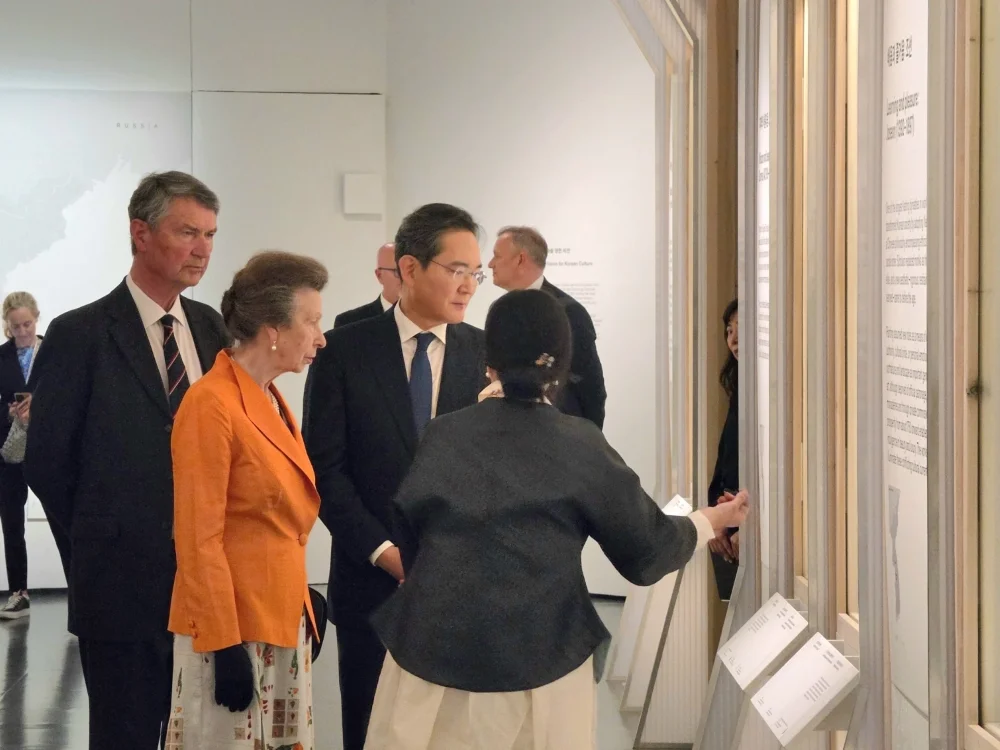
At the reception the previous evening, Samsung chairman Jay Y. Lee welcomed Princess Anne. His mother Hong Ra-hee and sisters Lee Boo-jin and Lee Seo-hyun also attended. Leaders from ASML, Merck, ZEISS and imec joined the guests, placing people from Samsung's industrial relationships in a room devoted to Korean art.
The exhibition itself ranged from historical treasures to works by Nam June Paik, Lee Jung-seop and Park Rehyun. That range gave visitors a country encountered through artists working in different circumstances and media, beyond the consumer technology or contemporary entertainment through which many knew it.
Five years after the donation, the works had acquired new public lives: objects of study in Korea, differently interpreted exhibitions abroad and images available on household screens. London's opening placed the collection before another museum audience, extending those new uses of the donated works through its own selection and interpretation.
Source: Samsung UK · London opening, US visits and reception, 1 October 2026DSML research · 8 October 2026 · Revised 31 October 2026