Reported evidence.
CJ announced a five-floor Seongsu retail concept in November 2024. Its February 2025 account confirmed the opening and reported approximately 500,000 cumulative visits from November through January. Company internal data attributed 70% of sales to international consumers. These are store-level promotional disclosures, not audited group results, unique-customer counts or evidence of overseas sales.
1. CJ: new Seongsu retail concept2. CJ: Seongsu visitor and sales update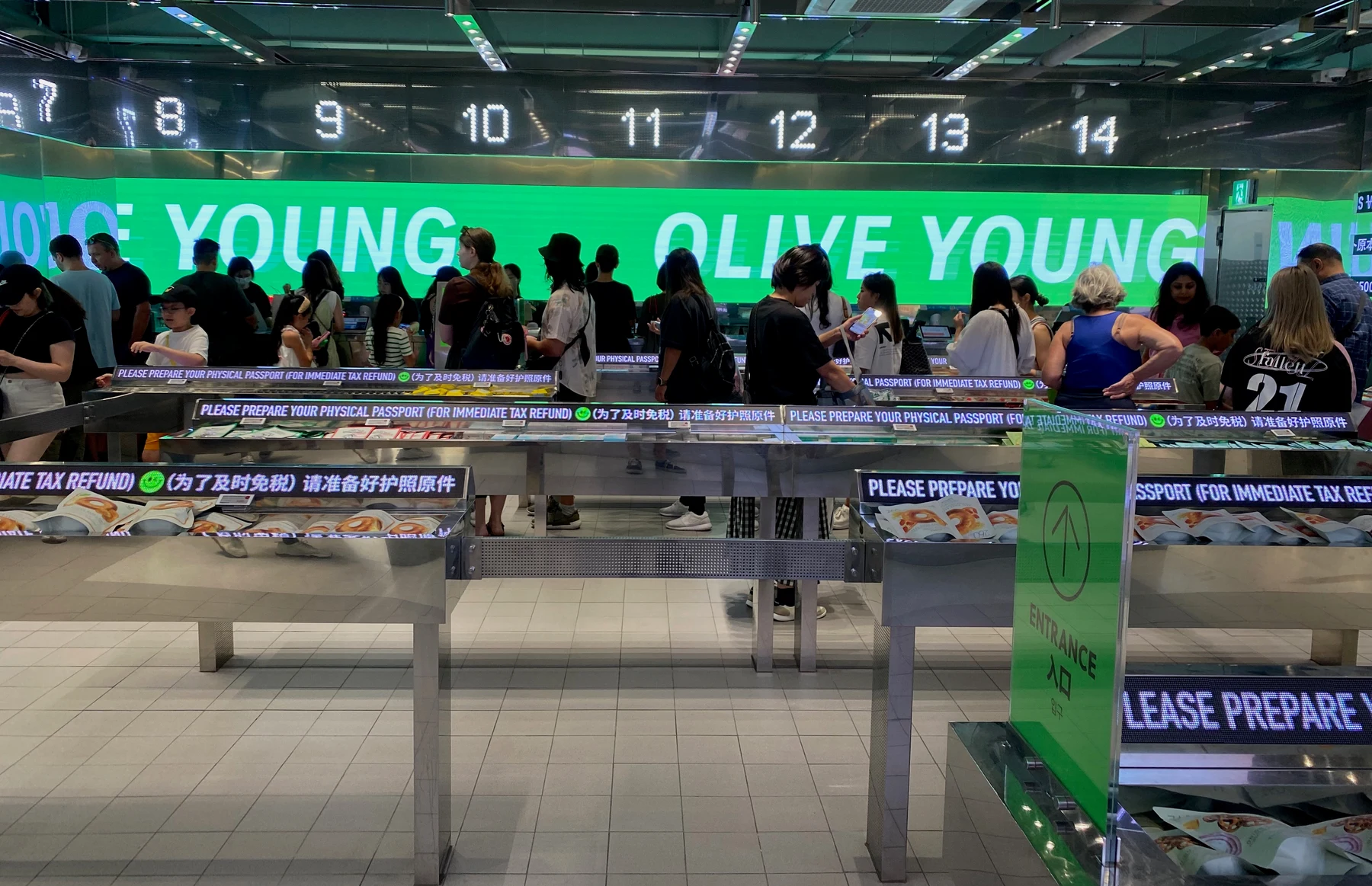
Investment interpretation.
The economic experiment is to make a Korean retailer a destination that lowers the discovery cost of several brands simultaneously. A visitor can compare textures, prices and routines in one physical setting. That creates a potential advantage over an individual brand showroom, which must fund its own attraction and explain its range without adjacent alternatives. The investment case is nevertheless about the value of that comparison process, not the size of the queue. A flagship becomes productive infrastructure only when the information it creates improves assortment, conversion and replenishment elsewhere in the network.
Economic assessment.
A larger experiential store needs more rent, fit-out, labor, testers and cleaning than a basic replenishment shop. Some of those costs support direct transactions; others purchase learning or supplier relationships. Management should allocate them accordingly rather than credit all future brand growth to the flagship. Inbound visitors also create a different demand pattern from local routine buyers. Their basket can be large but their next purchase may occur through a foreign retailer or cross-border platform. The retailer must identify which repeat transactions it actually retains before treating tourist spending as durable customer lifetime value.
The Value of Comparison
A multi-brand destination changes the unit of competition from a single product claim to a shopping journey. For a consumer uncertain about Korean labels, comparing several products can reduce the risk of an unsuitable purchase. For the retailer, that comparison provides observations about substitutions and complementary purchases. The commercially useful information is not simply which shelf attracts attention, but which alternatives customers reject at comparable prices and which combinations survive after promotional displays change.
That information can improve purchasing discipline. If a new ingredient category attracts visits but not baskets, a buyer can reduce reorder commitments before stock spreads across ordinary stores. If shoppers consistently combine a cleanser with a specific treatment, the retailer can adjust neighboring placement and replenishment. These are analytical possibilities, not disclosed outcomes of Seongsu. They explain why a flagship should be evaluated against the decision quality it produces as well as its own four-wall contribution.
Tourist Baskets and Repeat Demand
The reported international sales concentration makes the store a useful laboratory for inbound demand, but an unusual proxy for the Korean retail network. A traveler has a limited shopping window and may buy gifts or accumulate several months of skincare. A resident can defer purchases and compare online prices. Combining those customers in one average transaction measure obscures whether the store succeeds through destination spending or routine attachment.
For a Korean supplier, tourist demand can create an export lead without being an export sale. Products bought in Seoul may later encourage a foreign retailer to list the brand, yet that retailer still needs compliant packaging, dependable replenishment and local marketing. The economic chain contains several separate transactions. Management can build value by making those transitions easier, but should not recognize foreign distribution success merely because international shoppers carried products out of a domestic store.
Floor Productivity
The vertical format creates a practical allocation problem. Upper-floor experience or meeting space can support the brand platform while generating less immediate sales per square meter than a ground-floor retail section. An indiscriminate sales-density target might cause management to remove useful discovery functions. An equally indiscriminate strategic-investment label could protect permanently unproductive space. The correct approach distinguishes retail contribution, partner-service value and measurable experimentation.
Testers and staff recommendations are especially important because they consume scarce labor hours. A demonstration that increases conversion on a low-priced item may still be uneconomic if it requires lengthy individual attention. Group demonstrations, reusable signage and carefully selected hero products can spread the cost. The question is whether the experience increases net basket contribution enough to cover its operating burden, including the wasted samples and stock discrepancies that ordinary headline footfall does not reveal.
A Platform With Bargaining Power
The retailer's ability to select and compare brands can strengthen its negotiating position. A supplier may accept launch support requirements because access to a visible destination is valuable. That arrangement can finance discovery more efficiently than each brand building its own flagship, but it also concentrates dependence. If the retailer controls both consumer observation and shelf access, the supplier may receive little insight into why a product succeeds or fails.
An economically stable relationship therefore needs more than a short listing contract. Suppliers benefit from timely sell-through data and clear reorder expectations; the retailer benefits from quality, availability and products that distinguish its assortment. Excessive upfront inventory commitments can transfer launch risk to small brands without improving consumer fit. A repeatable platform should reward reliable replenishment and distinctive formulations, not merely the suppliers best able to purchase temporary visibility.
What Can Travel
The portable asset is a merchandising and service process, not the exact building. A store abroad cannot assume the same tourist concentration, labor economics or familiarity with Korean products. It may require fewer brands, more explanation and a narrower opening stock range. Seongsu's experience can inform that design only if the company separates location effects from functions that work across customer groups.
This distinction also matters for capital allocation. A successful destination might justify one flagship while failing to support a large chain of equally elaborate stores. Smaller formats can use the flagship's learning without duplicating every cost. The strategic benefit is greatest when one expensive discovery node improves many lower-cost selling points. That would constitute a network advantage; simply repeating a photogenic format would constitute additional fixed commitments.
Geographic analysis.
China
Reported connectionCJ identifies Chinese visitors among the store's international customers. This is inbound Korean retail activity, not a disclosed mainland distribution contract.
Japan
Reported connectionJapan is identified as the leading overseas visitor origin. Local Japanese replenishment would require separate channel economics from tourist purchasing in Seoul.
Other Asia
Reported connectionSoutheast Asian visitors are reported. Climate, language and local retailer requirements remain country-specific; the store supplies no regional revenue allocation.
United States
Reported connectionUS visitors are mentioned in the company account. The comparison question is whether experience-led discovery can retain a reorder when the customer returns home.
Europe
Reported connectionEuropean visitors appear in the reported mix. The case does not demonstrate EU-compliant distribution, retailer listings or European commercial margins.
Counterpoint.
A destination flagship can be valuable even if many tourists never buy again through Olive Young. Their purchases may generate immediate contribution and strengthen the retailer's supplier proposition. The narrower concern is attribution: those benefits should be measured directly rather than converted into an unsupported claim of global recurring revenue. A modest but profitable domestic destination is a legitimate outcome.
Underwriting questions.
- How are visitor counts deduplicated and international sales classified?
- Which experiential functions improve net contribution after staff, tester and space costs?
- What proportion of subsequent purchases remains within Olive Young's channels?
Primary sources.
- CJ: new Seongsu retail concept2024-11-08
- CJ: Seongsu visitor and sales update2025-02-24
DSML research · 8 October 2026