Reported evidence.
Sephora announced its Olive Young partnership on 20 January 2026. The initial plan covered North America and selected Asian markets, with later markets scheduled for 2027. Sephora's August release described a 19-brand US assortment and an August 20 launch. CJ subsequently reported the US debut in more than 580 locations. The agreement and its implementation are one event, not separate cases or evidence of completed future-country launches.
1. Sephora: Olive Young strategic partnership2. Sephora: US curated assortment launch3. CJ: US rollout confirmation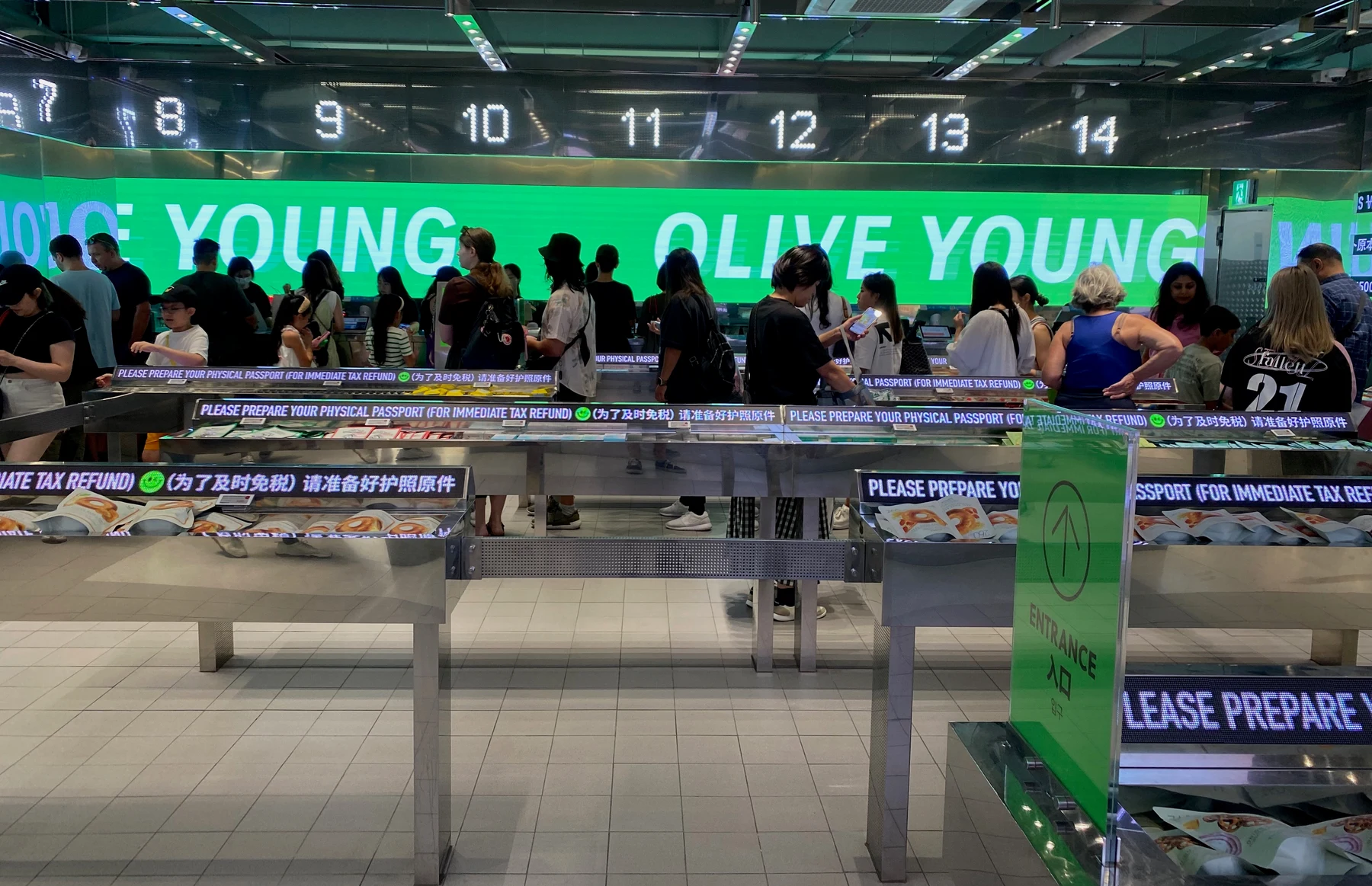
Investment interpretation.
The unusual asset being internationalized is not a single Korean trademark but a selection process. Olive Young can screen products and assemble a coherent Korean offer; Sephora can place that offer inside an existing customer relationship. This may reduce the burden on small suppliers that would otherwise negotiate separately with a global retailer. The strategic advantage depends on whether the curation improves replenishment and assortment productivity after the novelty phase. It is not established by the number of launch doors, which measures distribution availability rather than consumer acceptance.
Economic assessment.
The structure can avoid the capital burden of opening hundreds of wholly owned stores, but it does not eliminate distribution cost. Inventory preparation, compliance, displays, logistics and launch communication still have to be financed. Their allocation between retailer, curator and individual brands determines whether the apparent reach is attractive. Revenue can be recognized at different points in the supply chain while final goods remain unsold. Any evaluation should distinguish the curator's commercial consideration from brand wholesale receipts and Sephora's retail sales, without inventing undisclosed revenue shares or fees.
Selection as a Commercial Service
A buyer function can create value by reducing search costs on both sides of the shelf. Consumers obtain a bounded assortment rather than an overwhelming catalogue. The foreign retailer obtains products evaluated by an operator close to Korean supply. The curator can also identify which products require routine explanation and which can communicate their function quickly. These decisions matter because shelf space and staff attention are limited even inside a large retail network.
The risk is that selection becomes a temporary marketing badge. If a curated zone contains products already widely available at lower prices, it may add little economic value. The better test compares conversion, replenishment and markdown rates with alternatives using similar space. A successful curator should be able to explain why a product belongs in the assortment and when it should leave, rather than merely collect fashionable brands.
The Launch Inventory Chain
A broad opening creates many small inventory positions at once. The supplier may produce a large batch, the logistics operator may divide it by store, and the retailer may keep a reserve for replenishment. Even modest stock per door becomes material when multiplied across a network. This working-capital exposure arrives before repeat demand is known, and it can be obscured by a strong initial wholesale shipment.
The economic design should allow uneven learning. A moisturizer may reorder quickly while a more unfamiliar treatment needs explanation or different placement. Uniform replenishment targets can overstock weaker products. A launch contract that allows assortment adjustment, transparent returns and timely sell-through data is therefore more useful than a headline minimum order. These are analytical requirements; the releases do not disclose the partners' inventory ownership or return rights.
Borrowed Trust and Brand Independence
The shared format lends two kinds of trust: the Korean curator's product knowledge and the global retailer's customer familiarity. That can be particularly useful for an emerging label with limited overseas advertising resources. Yet trust borrowed from a platform is not identical to loyalty owned by a brand. A customer may remember the Korean beauty zone while failing to remember which supplier made the product.
Brands need recognizable packaging, a clear use case and consistent availability to convert platform discovery into independent preference. Excessive changes to range or claims can interrupt that conversion. The curator also has an incentive to rotate new brands, because discovery is part of its proposition. The commercial balance is between freshness for the platform and sufficient continuity for a supplier to recover its launch investment.
A Territory Sequence
The planned country sequence should be understood as a staged route, not a completed global footprint. A US assortment cannot automatically satisfy rules and consumer expectations in Hong Kong, Singapore or Thailand. Even where retail branding is common, local teams may choose different products and promotional calendars. The announcement offers a framework for expansion, while individual country launches remain operating projects.
The 2027 markets sit beyond this research window and are not counted as realized events. Their option value is still relevant: a successful initial programme may make further rollout easier because the partners have already built product files and operating routines. The benefit is reuse of preparation, not an assumption that later revenue will arrive. Failure in the first market could equally consume attention that would have supported a more selective route.
Who Learns From the Customer
Data access is a central bargaining issue. Sephora observes retail customers; Olive Young observes the curated portfolio; suppliers need evidence about their own products. If information stops at aggregate shipments, each participant may make a different and incompatible forecast. Strong sales in a few doors can conceal weak distribution elsewhere, while a system-wide average can conceal local opportunities.
Useful cooperation requires comparable definitions for sell-through, returns, promotions and stockouts. The same reported growth can result from a larger footprint, deeper stock or genuine replenishment. The partners' commercial agreement is not public, so the case cannot establish how they resolve those questions. It can identify the value at stake: reliable customer feedback is the mechanism that turns an international listing into a repeatable distribution asset.
Geographic analysis.
China
Reported connectionHong Kong was included in the announced initial route. This is not evidence of mainland-China access or mainland revenue.
Japan
DSML comparisonJapan was not identified in the initial announcement. A Japanese route would need its own retailer proposition and assortment economics.
Other Asia
Reported connectionSingapore, Malaysia and Thailand were named in the planned initial programme. Their announcement does not establish completed local sales.
United States
Reported connectionThe August US launch is subsequently reported by both partners. Store count establishes availability, not a disclosed programme contribution margin.
Europe
Reported connectionThe UK was named for 2027 expansion, outside the qualifying window. It remains a future plan rather than a realized European launch.
Counterpoint.
The alliance may be worthwhile even before individual brands build strong direct loyalty. A retailer can earn from rotating discovery assortments and a curator can broaden supplier access. But that is a platform model, not proof of durable economics for every participating brand. Supplier-level concentration and launch-cost recovery remain separate investment questions.
Underwriting questions.
- Who owns opening stock, and who bears returns or markdowns?
- What retail data reaches each supplier, and how quickly?
- How is programme consideration separated from brand wholesale revenue?
Primary sources.
- Sephora: Olive Young strategic partnership2026-01-20
- Sephora: US curated assortment launch2026-08-04
- CJ: US rollout confirmation2026-08-27
DSML research · 8 October 2026