Reported evidence.
Parnas announced the 15 September 2025 opening of The Westin Seoul Parnas, with 564 guestrooms including 144 Club Rooms. Its 12 September release describes a 702-square-meter club lounge accommodating up to 149 guests, wellness facilities, event venues and a guest mobile platform. The launch offer was valid from 15 September to 10 October and included discounts for qualifying multi-night reservations. These are inventory and operating-proposition disclosures, not achieved occupancy or profit.
1. Parnas / Westin Seoul Parnas operating strategy and opening2. Parnas / dated opening offer and booking conditions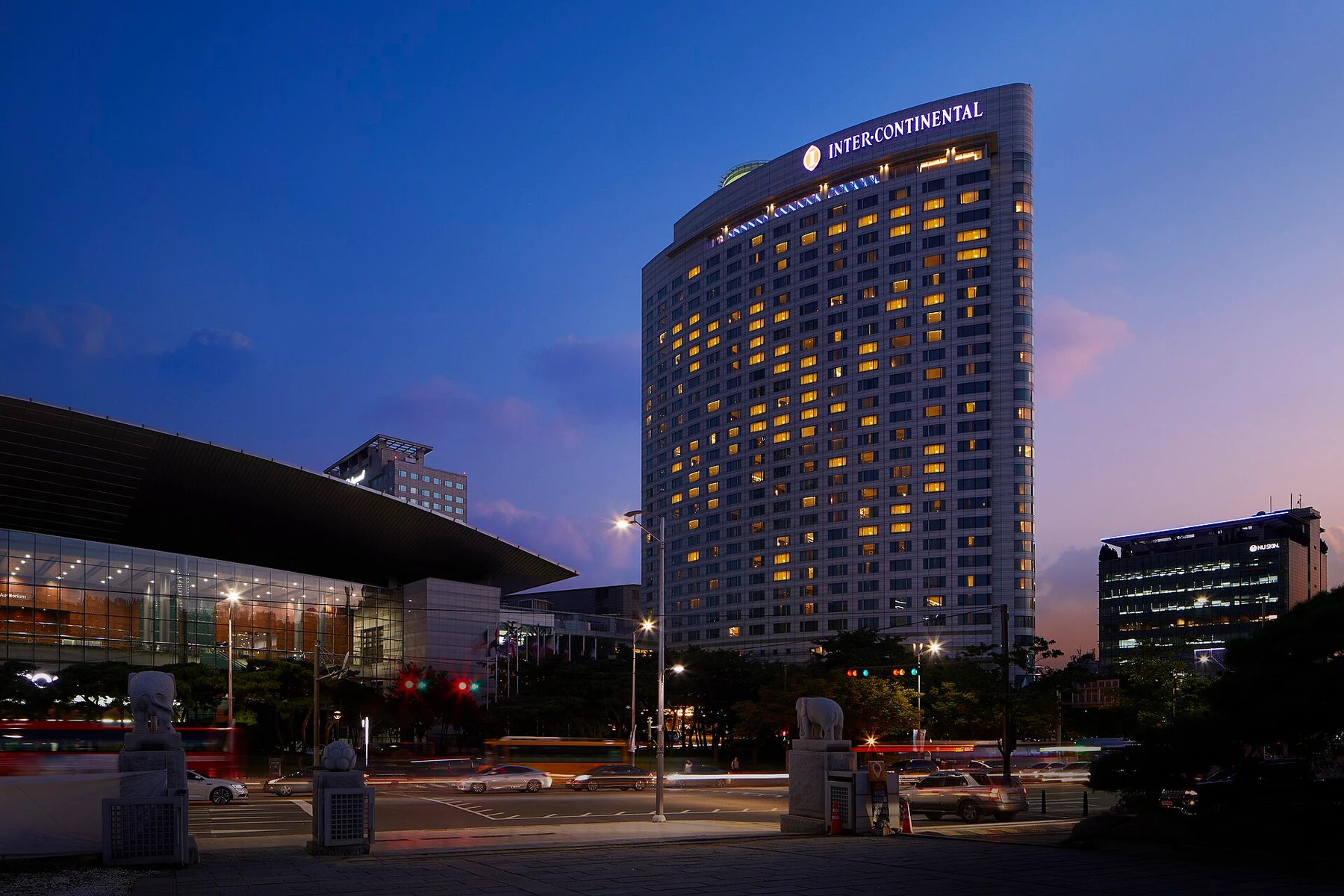
Photograph source · CC BY-SA 4.0 for the photograph; attribution, change notice and share-alike for image derivatives. Separate architectural/trademark rights and endorsement are not granted.
Investment interpretation.
Repositioning changes how a large fixed asset competes without making its operating capacity unlimited. Club inventory, event space and wellness services can raise total spend per guest, but each competes for staff time and shared facilities. The investment question is whether the brand and service redesign improve the cash yield on the existing location more effectively than simply retaining the previous product or pursuing a smaller refurbishment.
Economic assessment.
The opening inventory creates a concrete capacity map. Club rooms are a subset of guestrooms, while lounge occupancy is a different denominator. A revenue-management decision that sells every club room at a premium must still allow for simultaneous lounge demand and service intensity. Net hotel contribution depends on the room mix, ancillary margin and the cost of fulfilling the wellness proposition; no disclosed ADR or occupancy supports a numerical payback calculation.
A Different Competitive Set
Parnas frames the product around urban wellness in a district combining business, culture and leisure. That positioning seeks demand beyond conventional overnight accommodation. A business traveler may pay to maintain a routine; a leisure guest may value the lounge and dining; a local resident may use the fitness or event offering. These cohorts compete for some of the same operating resources but have different visit frequencies and acquisition costs. Their contribution should be evaluated separately rather than summarized as one premium customer.
The alternative products include other large Seoul luxury hotels, serviced accommodation and specialized wellness facilities. A combined hotel can reduce the inconvenience of purchasing services separately, but it must remain credible in each activity. A room-rate premium cannot indefinitely subsidize a poorly utilized service platform. Conversely, local demand can support facilities outside the hours when hotel guests use them, making the mixed proposition more resilient if access rules and service capacity are managed carefully.
The Club Inventory Constraint
The operator’s disclosed club-room and lounge capacities make segmentation commercially tangible. The lounge is a shared resource rather than an entitlement that can expand automatically with room sales. Service queues, dining replenishment and simultaneous guest arrival can erode the experience before accounting occupancy reaches a theoretical maximum. Revenue management should therefore examine guests per club room, timing of use and the contribution earned by different package combinations.
This is a capacity-allocation problem, not merely a branding problem. Selling a modest number of club upgrades at a strong premium may outperform selling many upgrades at a discount when service becomes congested. Where the hotel permits paid access or supplementary guests, those receipts should be compared with the displacement imposed on resident guests. The public release does not establish such commercial policies, but the disclosed physical limits make them specific issues for operating review.
Digital Service and Labor
Parnas describes a guest-only mobile platform for information, room controls, reservations and in-room dining. The economic benefit would arise if it reduces repeated administrative work or helps customers select underused services. A digital order does not remove the kitchen and delivery obligation. More convenient ordering can actually increase demand for a labor-intensive service. The operating case requires measuring task time, fulfilled orders and service quality, rather than assuming that adoption of a mobile interface reduces payroll.
Guest data can also inform room and ancillary pricing, subject to permissions and system integration. The most useful information is behavioral: which guest cohort uses which service, at what time and with what incremental contribution. A technology budget should be judged against alternative uses such as staffing, training or facility maintenance. The release identifies functionality, not independently measured cost savings or the ownership terms for every technology component.
Promotion and Stabilization
The dated multi-night offer shows that initial demand formation includes price concessions, even for a premium repositioning. A longer stay can reduce turnover work and spread acquisition expense across more nights. It can also displace a higher-priced booking on a constrained date. The relevant calculation compares the entire reservation’s contribution with the bookings that would otherwise occupy those nights, including the cost of benefits available to the room category.
Opening-period utilization is not automatically representative of stabilized trading. Marketing, introductory curiosity and discounted multi-night packages can support early demand before a repeat base develops. Management should preserve a clean opening cohort and compare it with subsequent guests once the incentives expire. That is especially important when evaluating whether the international brand or the redesigned facilities, rather than the promotion, explains the improvement.
Capital Already in the Location
A repositioned hotel carries the opportunity cost of capital and operating downtime. The public opening evidence does not disclose a complete refurbishment budget, so the investment analysis cannot calculate an exact return. It can establish the decision structure: compare incremental stabilized cash with the capital and trading contribution forgone during the transition. Existing operator experience can reduce execution uncertainty, but it cannot eliminate the requirement to fund the service standard after reopening.
A strategic capital allocation would set milestones for room mix, repeat demand, event conversion and facility utilization. It would also reserve resources for maintenance rather than treating every incremental receipt as distributable. The hotel’s value to a purchaser depends on the durability of that operating record and the continuing brand rights, not on the size of the opening inventory alone. Wellness becomes an investable differentiator when it creates repeatable contribution within the building’s real capacity constraints.
Geographic analysis.
China
DSML comparisonChinese guest demand should be segmented by booking route, travel purpose and ancillary use. The disclosed room count does not establish nationality-specific utilization.
Japan
DSML comparisonFor Japanese short-stay visitors, compare the room premium with actual use of bundled wellness and club benefits rather than assuming identical demand to local guests.
Other Asia
Reported connectionThe operator and reopened hotel are in Korea. Regional business and leisure demand may overlap, but the source provides no regional revenue split.
United States
Reported connectionWestin and Marriott Bonvoy supply international brand and distribution connections. Those links do not turn the Korean property into a US operating asset.
Europe
DSML comparisonLong-haul stays can alter acquisition-cost recovery and ancillary utilization. Test stay-level contribution instead of importing a European wellness-hotel margin.
Counterpoint.
A broad service proposition can make the hotel more useful and improve the yield on an established location. It can also create an expensive collection of facilities whose utilization does not match the room mix. The strong case is coordinated capacity allocation, not simply more premium amenities.
Underwriting questions.
- What stabilized contribution covers refurbishment, downtime and ongoing brand requirements?
- How are club-room sales matched to lounge demand and service capacity?
- Does the mobile platform reduce task cost or primarily stimulate additional service obligations?
Primary sources.
- Parnas / Westin Seoul Parnas operating strategy and opening2025-09-12
- Parnas / dated opening offer and booking conditionsOffer period 2025-09-15 to 2025-10-10
DSML research · 8 October 2026